Advanced Materials Are Features Not Products
With the recent Nobel Prize in Chemistry awarded for Metal Organic Frameworks (MOFs), I asked Gemini to estimate the total market value of the last ten Nobel Prize–winning discoveries in materials science:
Gallium Nitride (GaN) LED Chips - Physics 2014 - $29.9 Billion
Lithium-Ion Battery Materials - Chemistry 2019 - $38.5 Billion
Quantum Dots - Chemistry 2023 - $8.0 Billion
Topological Insulators - Physics 2016 -- $6.5 Billion
Giant Magnetoresistance (GMR) Devices - Physics 2007 - $1.8 Billion
Graphene - Physics 2010 - $1.0 Billion
Metal-Organic Frameworks (MOFs) - Chemistry 2025 - $0.5 Billion
Even allowing for fuzzy numbers, the trend is clear: winning a Nobel in materials science rarely translates into financial success. This stands in stark contrast to pharma—Moderna’s COVID mRNA vaccine alone generates billions in annual revenue, not to mention the rest of the mRNA pipeline.
This reflects a fundamental truth in materials science: we are problem-limited, not discovery-limited. Few markets can support the cost of developing entirely new, pure-play materials and bring them to scale. [1]
The deeper truth is that materials producers seldom capture much value. You may supply an essential input to a world-changing product, yet still earn only cost-plus margins. Spruce Valley quartz underpins the semiconductor industry, but its producers don’t collect 5% of TSMC’s gross revenue.
These realities make the idea of an “AI materials discovery platform” inherently challenging. Even if your AI discovers Nobel-worthy materials, you’re unlikely to profit from licensing. And the number of potential “software seats” in advanced materials R&D is far too small to sustain a venture-scale SaaS model.
That doesn’t mean nobody profits from new materials. The world’s most valuable hardware products are built on proprietary materials. Apple earns billions from the advanced materials that define the iPhone’s look and feel. NVIDIA does the same with the materials behind NVLINK. These are, not coincidentally, the first and third most valuable companies on earth.may have also noticed that these are the third and first most valuable companies in the world.
The key insight is that advanced materials are features, not products. A company with a black box that invents materials can make enormous returns—but only by integrating those materials into compelling products at scale. That’s difficult, but not impossible—and with the power of AI, increasingly feasible.
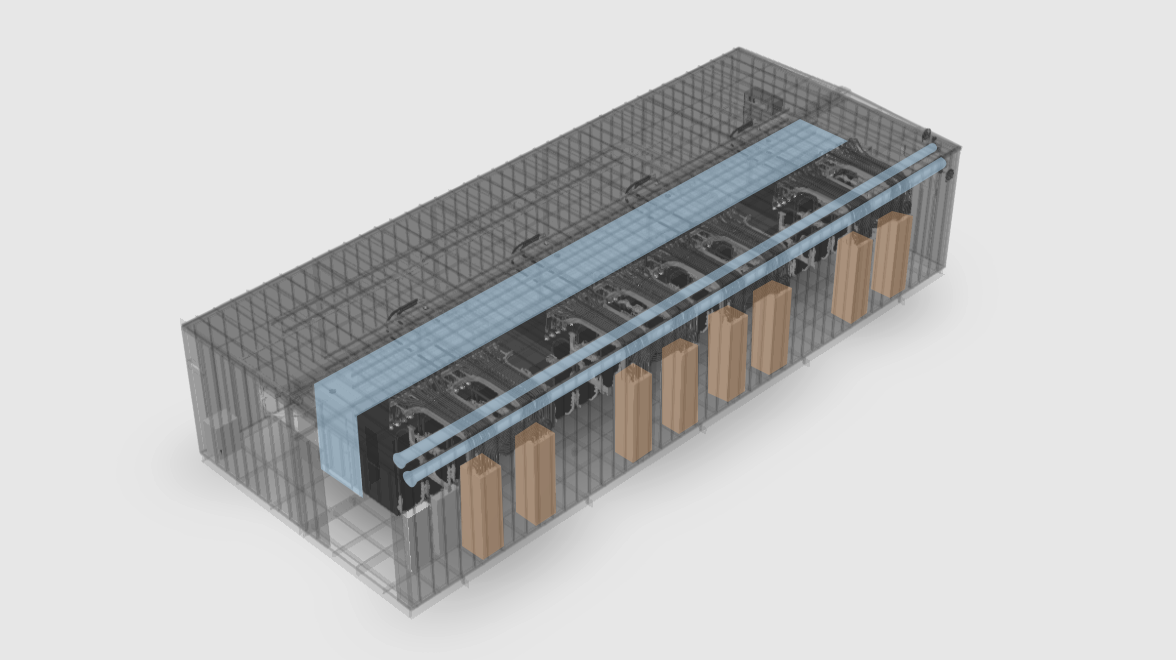
That’s been our strategy at Orbital. We’ve built the world’s leading, independently benchmarked AI models for advanced materials. We use them internally to discover materials, then integrate those materials into exquisite hardware we design and manufacture. Our goal is to ignite an industrial renaissance across the physical economy—starting with data centers.
—-
[1]It’s surprisingly hard to find a “hit” in advanced materials. Room-temperature superconductors, for instance, could revolutionize power transmission—but that market is already so price-sensitive we use aluminum instead of copper. Most potential “breakthroughs” face the same reality: transformative technology, but nobody is willing to pay for the transition.
Articles