BLOG
The Geography of Compute
July 10, 2026 · Jonathan Godwin, CEO, Orbital Industries
In 1990 America made over a third of the world's chips. Today the most advanced ones come from a single island, patterned by machines from a single Dutch town. How did the most widely dispersed industry on earth become the most concentrated, what are the risks, and what can we learn for the future of technology resilience?
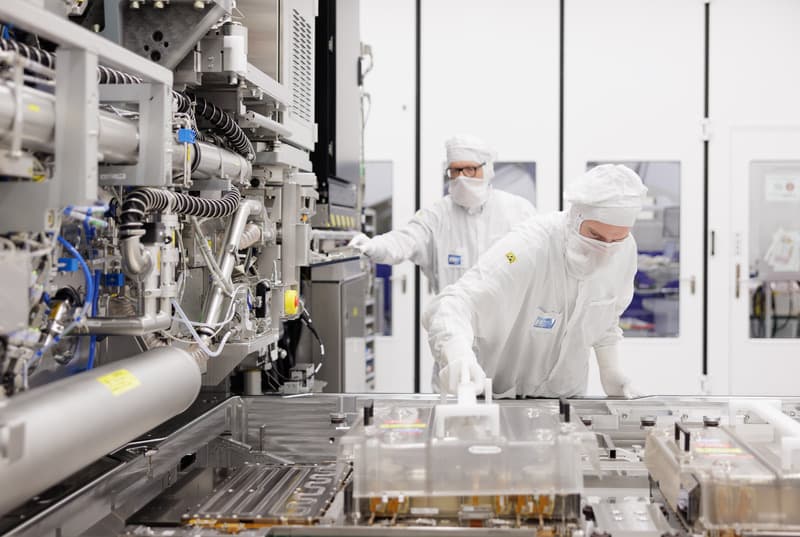
Every leading-edge chip in the world is patterned by a machine that comes from one town in the Netherlands. The town is Veldhoven, the machine is an extreme-ultraviolet lithography system, and the company that makes them, ASML, makes all of them. Each one is roughly the size of a bus, costs somewhere north of $200m, and there are only about forty built a year for a grand total of three serious customers, with no second supplier anywhere.
Those machines then feed, overwhelmingly, into fabs on a single island. That island is Taiwan, and in practice the fabs are owned by a single company, TSMC, which makes over 90% of the world's most advanced logic. The high-bandwidth memory stacked next to that logic in every AI accelerator comes mostly from two Korean firms. A great deal of the tooling, the wafers, and roughly half of the photoresist chemistry comes from Japan.
In short, the most sophisticated object humanity manufactures at scale passes, at some point, through a supply chain you could sketch on the back of an envelope. But it wasn't always like this, and that's the part worth pausing on. In 1990 the United States held roughly 37% of global chip-making capacity. That rapidly became barely 12% by the early 2020s. And the slide had started even earlier: at the beginning of the 1980s, US firms held more than half of worldwide semiconductor sales, a lead Japan had taken from them before the decade was out. The geography we now treat as a law of nature is roughly forty years in the making. So the question I keep coming back to is a simple one: how did an internationally interdependent, free-trading industry end up as one of the most concentrated? And, given how much now rides on it, what can honestly be done?
A chain of rational decisions
It's tempting to look for a villain here, a policy blunder, a stolen decade or a single bad bet, but what happened is quieter than any of those. Instead, it was the sum of a lot of individually sensible choices, made by different people in different countries, none of whom were aiming at the outcome we got.
The split that mattered most, the divorce of chip design from chip manufacturing, only became possible in the late 1980s. Through the 1970s a chip design was not a document, it was a craft: layouts were drawn by hand around the quirks of one company's specific manufacturing process, and a design made for one fab was simply meaningless in another. What changed was abstraction. In 1979 Carver Mead and Lynn Conway published a set of simplified, process-independent design rules that let designers work without knowing the details of the factory, and through the 1980s a new industry of design software gradually grew up around that idea, turning a chip design into a portable file that could be handed to any fab running a compatible process. Once designs were portable and fabs were unaffordable, splitting the industry in two stopped being a choice and became an inevitability.
Starting with Japan, its firms, Toshiba, NEC, Intel and Hitachi, dominated the 1980s by doing everything themselves: design, fabrication, sales, all under one roof. That integration was the source of their strength, right up until it wasn't. When the industry split in two, with fabless design houses on one side and pure-play foundries on the other, the Japanese giants were too vertically integrated to move. They kept trying to do everything, while their competitors got very good at doing one thing. From roughly half of global production in 1989, Japan's share fell below 10% by the late 2010s.
The opening that Japan left was widened, ironically, by American trade policy. American chipmakers accused Japanese firms of dumping memory chips below cost, and under threat of sanctions Japan signed the 1986 US-Japan Semiconductor Trade Agreement, agreeing to two things: its firms would stop selling chips below set floor prices, not just in America but in every market, and Japan would open its home market to foreign chips. (The famous tariffs came a year later, when the US judged Japan non-compliant and briefly imposed 100% duties on $300m of Japanese televisions, laptops, and power tools; a punishment aimed at Japanese electronics generally, not at chips themselves.)
With Japanese memory held artificially expensive everywhere in the world, Korean and Taiwanese entrants, who were not party to the agreement, could sell under that umbrella at prices Japan was now forbidden to match: Korea's share of the DRAM market climbed from 5% to 40% in the years that followed, while Japan's collapsed from 75% to 20%.
Taiwan took that room deliberately, with state money: in 1987 the government put around $100m into a new company spun out of its Industrial Technology Research Institute, run by Morris Chang, a Texas Instruments veteran. Chang's bet was that manufacturing chips was every bit as hard, and as valuable, as designing them, and that a company that only manufactured, and kept its customers' secrets religiously, could become indispensable to everyone at once. And he was right: TSMC made the foundry itself the product and won on manufacturing alone.
Korea did the same in memory. Samsung and what became SK Hynix built enormous fabs on government backing and flooded the DRAM market that Japan had pioneered. Today those two firms hold more than half the world's DRAM and NAND, and dominate the high-bandwidth memory that modern AI is bottlenecked on. All of this being the product of industrial policy sustained across decades and business cycles.
And then there's the American side of the ledger, where the story is one of walking away, and it is best told through one company. Intel was, for a generation, the most advanced manufacturer on earth, and the great exception to every rule in this piece. It stayed vertically integrated long after everyone else split apart, and under Andy Grove, whose management creed was literally "only the paranoid survive," that integration was a weapon: through the 1990s and 2000s the x86 monopoly in PCs and then servers funded fabs that ran a full process generation ahead of the field, and Intel's "tick-tock" cadence of alternating process and architecture upgrades effectively set the industry's clock.
But in the mid-2000s Intel passed on supplying the processor for the original iPhone, with then-CEO Paul Otellini later admitting the forecast volumes looked too small to justify the price, and so it sat out the mobile revolution that went on to fund its rivals. Then came the stumble in manufacturing itself: Intel stumbled on its 10nm process from around 2015 and stayed stuck on 14nm for years, in part because it refused to invest early in exactly those EUV machines from Veldhoven that TSMC embraced without hesitation. While Intel wrestled with its own fabs, the fabless designers simply rented TSMC's leading edge and pulled ahead: AMD, written off a decade earlier, took a large and growing share of the server CPU market under Lisa Su with TSMC-made chips, and Nvidia, which has never owned a fab in its life, took the AI GPU market almost in its entirety.
Line all of those dominos up and a pattern emerges: on one side of the Pacific, states treated chip-making as strategic, and paid for decades to keep it. On the other, firms treated it as a business like any other, optimized for margin and specialization, and offshored the hard, capital-heavy, unglamorous part. Both sets of decisions were defensible, and together they produced a world in which the most important physical technology of the century sits, at its most advanced tip, in just a handful of postcodes.
Why this is suddenly everyone's problem
For most of the past thirty years, this concentration was an efficiency story, and a good one. Specialization made chips cheaper and better, faster than anyone had a right to expect, and the fragility was a footnote.
AI is what turned the footnote into the headline: of the three inputs to AI progress, data, algorithms, and compute, it's compute that's done the heavy lifting, and by some estimates its contribution dwarfs the rest. That means the frontier of arguably the most strategically consequential technology of our time is gated by a physical pipeline that runs Netherlands to Taiwan to Korea to Japan, and barely touches the countries doing most of the model-building.
This is the part of "AI sovereignty" that tends to get lost. The phrase is usually taken to mean something about models: can a country train and run its own systems without asking permission? That matters of course, but it's the easy half; the harder half is physical. It doesn't help to own the model if the compute it runs on is fabricated entirely inside the potential blast radius of someone else's geopolitics. A blockade in one strait, an incident in one Dutch town, a decision by one government about who its national champion may sell to: any of these can reach into a data center in London or Virginia and switch off the future. Sovereignty over bits is not worth much without some sovereignty over atoms.
It's worth being concrete about this worst case scenario, because the instinct is to just picture a shortage, something the world absorbs and grinds through the way it did in 2021. When a drought in Taiwan and a fire at a single Japanese plant tightened chip supply that year, the disruption was partial and temporary, yet it still cost the global auto industry around $210bn in lost sales, because there was no spare capacity and no inventory anywhere to absorb the shock. A conflict over Taiwan would take the world's supply of advanced chips to effectively zero, and hold it there. A leading-edge plant depends on an unbroken drip of servicing from the Netherlands, chemicals and wafers from Japan, and the tacit knowledge of tens of thousands of engineers, none of which are available during a war.
Play that out and the damage doesn't stay in AI, or even in tech. Bloomberg Economics has modeled a war over Taiwan at roughly $10 trillion. That's close to 10% of global GDP in the first year alone, a larger shock than the pandemic, the financial crisis, or the war in Ukraine. Their figure climbs toward 14% if the world turns out to be worse than expected at substituting the missing chips.
That's why the physical supply of compute has quietly become one of the central vulnerabilities of the world economy, and the single central vulnerability of AI.
What can actually be done now?
The reason advanced manufacturing concentrates is that it's punishingly hard and slow to stand up: a leading-edge fab is one of the most complex things people build, and the knowledge to run one is accumulated the expensive way, over many years of trial and error. Anything that compresses that curve (shortening the time and lowering the cost of bringing a new manufacturing capability online) buys back resilience. There is potential for AI to speed up the learning curve of new industrial facilities, so that this tacit knowledge is generated faster and hard physical capability becomes feasible to build in more than one place.
But that will only ever be part of the story, because the history above argues against a purely technological fix. What created this concentration was policy, capital and time: with governments who were willing to fund a strategic industry through decades of losses. Reversing our current situation would need the same things in place.
Thankfully, that seems to be beginning to happen. The CHIPS Act of 2022 put $52bn on the table, enabling TSMC to start making advanced chips in Arizona. A few years ago that looked impossible, so I'm pleased to see genuine progress. But it's also years behind schedule and far over budget, precisely because a fab is not a software problem and cannot be treated as one. AI can help you climb the learning curve, but it cannot vote the subsidies, resolve the labor shortages, or conjure thirty years of accumulated process knowledge that, in some cases, was never even written down.
So the honest version is this: AI is likely a necessary ingredient of a more resilient supply of compute. It shortens the odds; it does not change the game on its own.
And that brings me back to where we started. What strikes me most about the geography of compute is how little of it was lost in a fair fight. For the most part the West had the technology and chose, rationally, incrementally, one sensible quarter at a time, to let it go somewhere else. In some ways that is good news: if the constraint was a set of choices, it can be chosen differently, though the fix will look a lot like the thing that built East Asia's lead in the first place (patient capital, industrial policy, and a long time horizon). The wider point is one that hardly needs arguing anymore. In a more volatile world, ownership of core technology has stopped being a preference and become a non-negotiable, for AI and for everything downstream of it. The compute has to come from somewhere, and the countries that want a say in their own technological future will have to make some of it themselves.