BLOG
The Energy Is Free, The Rest Isn't.
July 16, 2026 · Jonathan Godwin, CEO, Orbital Industries
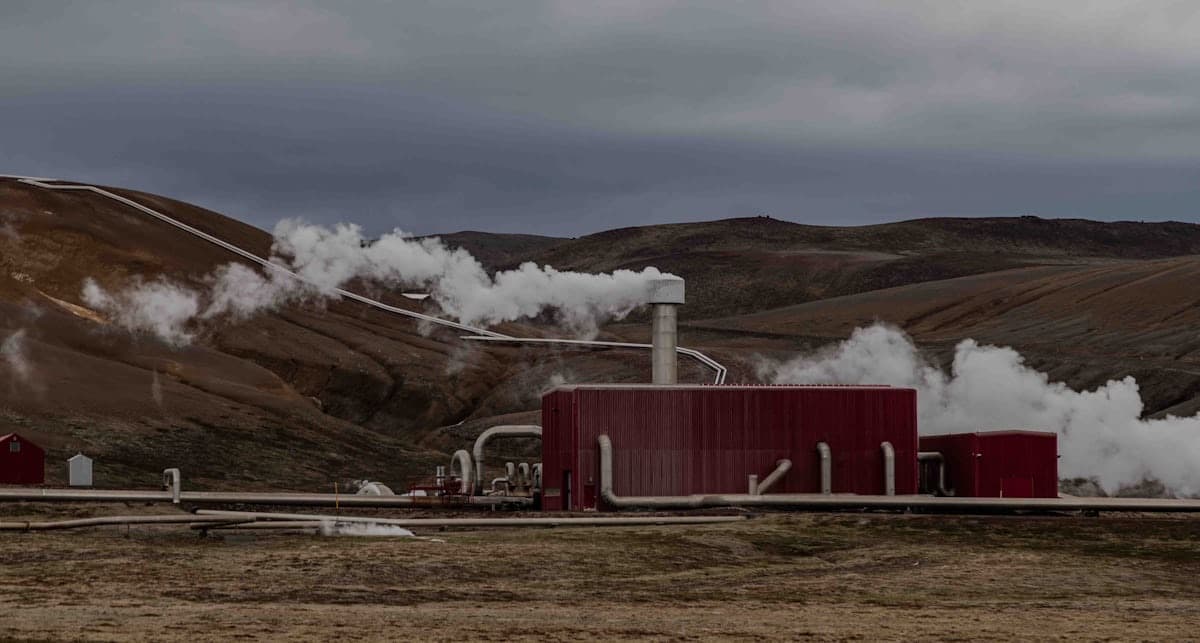
Britain sits on enough always-on clean power to cover most of its electricity, and enough heat to warm its buildings for a thousand years. In February 2026 it switched on its first geothermal power station to reach that heat, half a century after it first went looking.
Near Redruth in Cornwall stands the United Downs power station. It came online in February 2026, and it's the first plant in Britain to make electricity from the heat of the earth. Its production well runs to 5,275 meters, the deepest hole ever drilled on British soil, and it took the better part of a decade to complete. By any ordinary measure its production is still relatively small: 3 MW or so, enough energy for perhaps ten thousand homes, which is about 0.01% of national demand. But that solitary output is just the beginning.
The granite under Cornwall is unusually radioactive, rich enough in thorium, uranium, and potassium to generate its own heat, which leaves it running roughly twice as hot as the British average at any given depth. The most recent national survey, published by Project InnerSpace in February, puts the country's technically recoverable geothermal electricity at around 25 GWe, close to three-quarters of what Britain currently uses, alongside a heat resource large enough to cover national demand for something like a thousand years. The heat is real, it's enormous, and unlike almost everything else we file under "renewable" it never stops: it remains unaffected by whether the wind is blowing or the sun is shining, and it will still be there, at a steady couple of hundred degrees, long after the last gas turbine has been switched off for good.
So if the resource is genuinely that large and that dependable, the obvious question is why almost none of it has reached the grid in the fifty years we've known it was there.
The price of the dig
Cornwall has understood its own heat for a long time: in the late 1970s, when an earlier energy shock had Britain hunting for homegrown power, engineers from the Camborne School of Mines began one of the world's first Hot Dry Rock experiments at Rosemanowes quarry near Penryn, fracturing the granite and circulating water through it to prove the principle that United Downs would eventually turn into a business. The geology has since been surveyed, the faults mapped, and the temperatures logged. What has never fallen far enough is the price of reaching them, and that price is set almost entirely by drilling, which accounts for somewhere between 30% and 57% of the cost of a geothermal plant and pushes toward the upper end of that range in hard rock.
To see why, it helps to picture what the drill is up against. Granite is one of the least accommodating materials in the crust, ten to twenty times harder than the concrete of a pavement, with a compressive strength that runs toward 250 MPa against perhaps 40 for the soft sedimentary shales the oil industry has spent a century learning to drill quickly. In those shales a modern rig can advance at hundreds of meters an hour, while in hot Cornish granite the same rig manages closer to just five. The problem compounds with depth, because at the 200 degrees Celsius and beyond that make the heat worth having, even polycrystalline diamond, the hardest thing we routinely manufacture, blunts and fails under the combined heat and load. Each failure means tripping five kilometers of steel out of the ground to change the bit and running it all the way back down, with the rig and crew billing at full day rate throughout.
Unfortunately, all that accumulated cost ends up in the price of the power. United Downs sells its electricity under a contract worth £119/MWh in 2012 prices, while offshore wind has cleared Britain's recent auctions at about half that, and the government's own reviewers have put geothermal's premium down to the expense of drilling safely.
Reduced to its essentials, the obstacle is a surprisingly small one: what stands between Britain and a large, clean, always-on power source is how long a few centimeters of engineered material can keep cutting hard rock, kilometers down, before heat and abrasion wear it away.
How it gets cheaper
Some of the cost of drilling erodes through sheer repetition. The clearest demonstration of this comes from Fervo Energy in the United States, which has been drilling hot granite in Utah and treating every well as a rehearsal for the next. Across the first four horizontal wells at its Cape Station project, the cost of a single well fell from $9.4m to $4.8m, nearly halving, and by the fourth the rate of penetration had beaten the official American projections for 2035. Fervo managed this by importing, wholesale, the drill bits and the accumulated field habits of the shale industry next door, moving two decades of hard-won oil-and-gas practice into geothermal in the space of a single campaign. This clever structuring of procurement is something we're seeing other industries like data center construction adopt too.
That kind of learning has a floor, though, and the floor is the material itself. You can optimize the schedule, the drilling mud, the well path, and the crew, but at the bottom of it all you're still asking an engineered cutting edge to work through the hardest rock in the country while the surrounding heat degrades it almost as fast as it cuts. What's left at the root is a materials problem, and there are three quite different ways to try and solve it.
The first is a design-engineering challenge; making the cutting edge last longer. It's incremental work, but far from marginal: engineers at the drilling firm NOV recently redesigned a diamond-composite bit that cut its time on the bottom of the hole by 63% and drilled 500 feet of granite at better than a hundred feet an hour without once coming up for repair.
The second is to reach past the drill-bit materials we already have toward genuinely new ones; harder and tougher and more stable when hot. The American Department of Energy is funding work at Argonne on superhard nanocomposite bit materials meant to double the rate of penetration outright. This could become more interesting as materials research becomes integrated with AI infrastructure platforms. Searching the space of possible hard, heat-stable composites is exactly the sort of vast combinatorial problem that machine-learned models of materials have started to make tractable, collapsing discovery timelines in things like coolants, semi-conductors, and catalysts over the past few years.
The third route is the most radical, which is to rethink the engineering process itself and to stop grinding at the rock at all. Quaise, a company spun out of MIT in 2018, drills with millimeter waves generated by a gyrotron, vaporizing the rock with a beam and leaving no cutting surface in the hole to wear out. Last year, at a granite quarry in Texas, it bored a hundred meters this way, ten times faster than any previous attempt, and it's aiming for a pilot power plant by 2028. Its ambition runs beyond cost, because with no bit to destroy, Quaise believes it can push far deeper and hotter than conventional drilling allows, into rock at 400 degrees and above where water turns supercritical and carries several times the energy of ordinary steam.
All three approaches aim at the same target: using advanced materials and engineering to bring the cost of the drilling down far enough that the free heat below finally justifies the trip.
What the heat is worth
None of this would feel urgent if the value of the heat energy had stayed where it was in 1996. What has changed now is the demand. Firm, always-on power has quietly become one of the most valuable things in the economy, because the build-out of artificial intelligence has turned electricity, and specifically the dependable, build-anywhere kind, into the binding constraint on the whole enterprise. A data center needs power at three in the morning in January and in every other hour of the year, for twenty years at a stretch. That steady, weatherproof profile is precisely what geothermal supplies. It's frugal with land as well, occupying only a small fraction of the ground a wind or solar farm needs for the same output, which counts for a great deal when the sites worth powering keep getting larger and harder to place.
There's an interesting circularity in this: the same wave of AI investment that has made always-on power so crucial and valuable is also producing the most promising tools for making the drilling cheap. So the technology that most needs the energy today may turn out to be the one that lets us reach it. The demand and the means of supply are, in a real sense, the same phenomenon.
Which brings me back to that solitary 3 MW in Cornwall. For most of a century, British geothermal has been quietly filed under geological bad luck: no volcanoes, the heat too deep, never quite worth the effort. What has actually kept it locked away is the wear life of a small piece of superhard material, and materials are something we are finally able to engineer to order. That makes the heat beneath Cornwall a great deal more reachable than a century of leaving it alone would suggest, and whether Britain now decides it's worth the drilling is a different question, and a far more hopeful one to be left with.