BLOG
How AI Cut Our Submittal Turnaround from 2 Weeks to 2 Days
September 23, 2026 · Jaden Weaver, Senior Mechanical Engineer, Orbital Industries
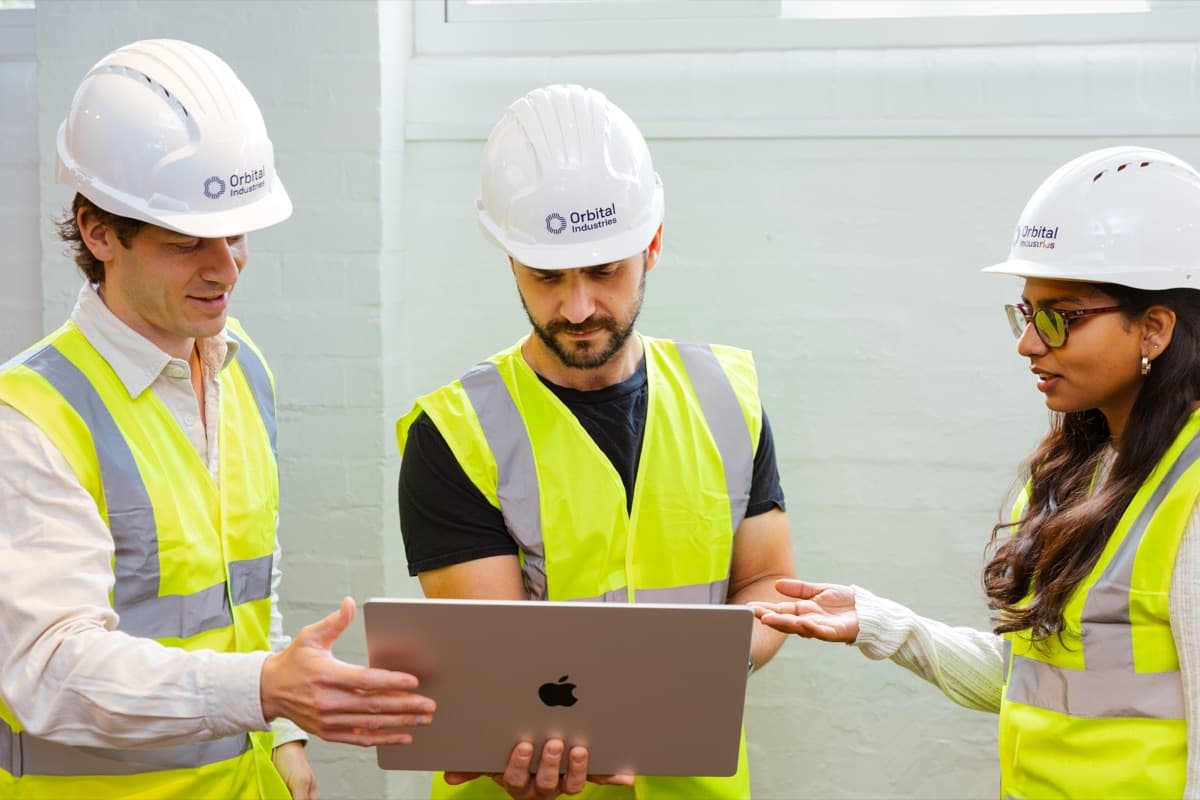
With engineers directing every step, AI is cutting submittal turnaround on mission-critical data center projects from weeks to days.
At Orbital Industries, we design mission-critical infrastructure for data centers, where a single design decision can affect equipment selection, lead times, and cost across the entire system. We built CurieOS to change the pace of how these systems get designed. In one CurieOS workflow, the elapsed time for a submittal package that used to take two to three weeks came down to just two to three days. This was possible with engineers directing every step.
Building Trustworthy AI
CurieOS is built on a simple principle: the fastest way to put effective AI to work on mission-critical engineering is to keep the engineer in every decision along the way.
On any given week, our team is fielding a backlog of design requests spread across emails, RFPs, meeting minutes, and project specifications. Each one is specific to its project, but the workflows stay the same. Clients are asking for submittal documentation packages, PUE (Power Usage Effectiveness) studies, WUE (Water Usage Effectiveness) analyses, TCO (Total Cost of Ownership) models, thermal studies, and full data center layouts. All of it needs to move fast so clients can make decisions and keep projects moving. CurieOS is how we work through that backlog without slowing down.
Tools in Practice
Across the projects we've worked on, three parts of the process used to involve a lot of manual compiling and cross-checking: submittal packages, product selection, and documentation review. That's where we've used AI so far, with the engineer directing every step throughout.
Submittal packages consisting of compiled product data, performance specs, engineering calculations, all organized and cross-referenced, mark the handoff from design to construction: once a client signs off, procurement and equipment ordering can begin. Depending on the submittal type, a full equipment schedule can take three weeks of elapsed time; a narrower cost study, closer to two. Either way, it's time that has to happen before procurement can start.
Using CurieOS, it's possible to cut your total turnaround time down to two to three days. The AI handles the data extraction, cross-references specs against project requirements, flags conflicts, and assembles the package, while an engineer reviews, validates, and signs off throughout.
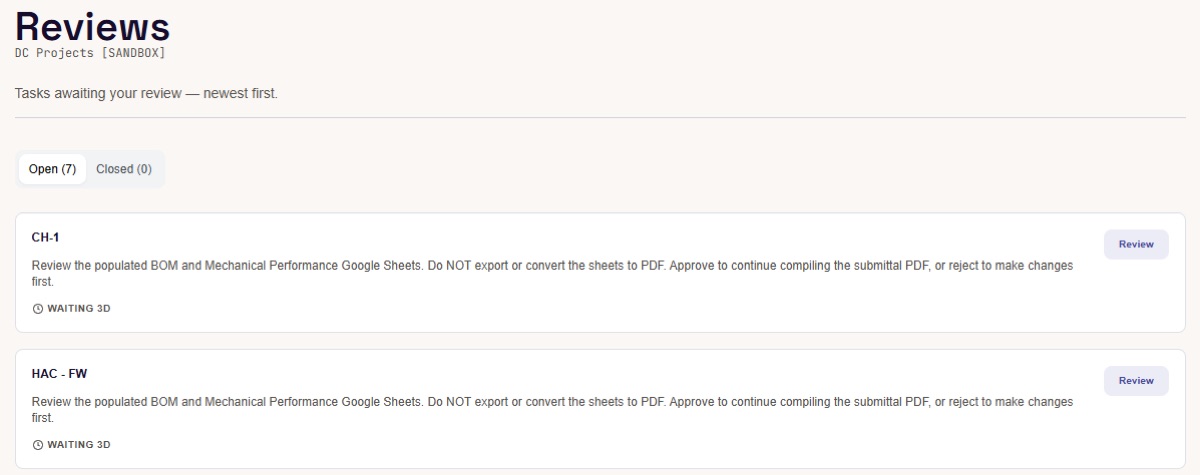
Review stages built into CurieOS
Product selection works differently but the time savings are just as significant. When a project lands with a set of mechanical and electrical requirements, someone has to go through manufacturer catalogs and datasheets, sometimes dozens of them, checking each one against the project's requirements to see which products actually meet performance needs. AI parses that in minutes, pulling the relevant specs, comparing them against the project criteria, and narrowing to a shortlist. The engineer weighs the trade-offs a spec sheet can't capture, e.g., vendor reliability and lead-time risk, but starts from a shortlist AI has already checked against the requirements instead of the raw catalog.
Documentation review is the third piece. Hundreds of pages of owner's project requirements, basis of design documents, and specifications don't just need to be read, they need to be checked against the design as it develops. CurieOS reads all file types, including drawings in their native format, builds a context graph of the requirements that affect your design, and updates it as new information becomes available. As you develop the design, the context graph gives you full visibility into why decisions were made, who made them, and when. That's how we track down the defining decision when large designs become constrained.
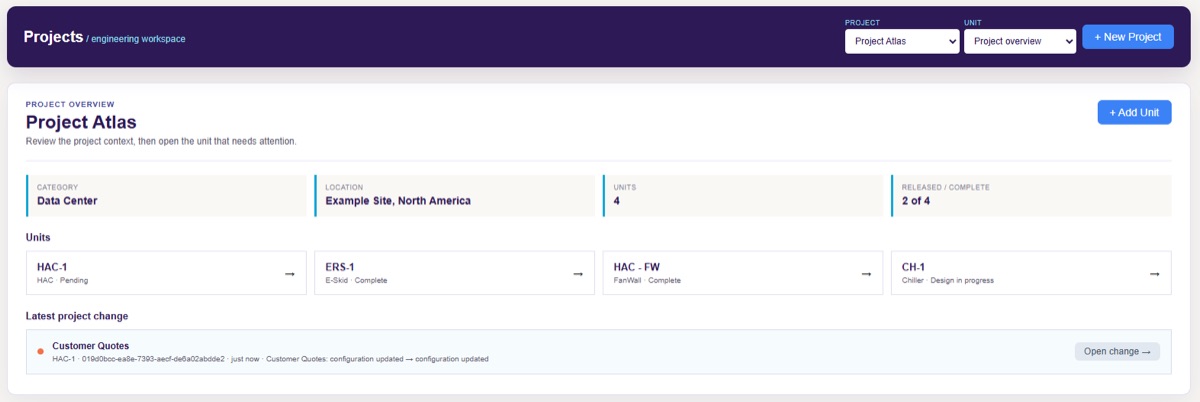
Project Database, Equipment Selection, and Submittal Tool built using CurieOS
Weeks of Modeling in One Afternoon
Here's an example from a project I worked on personally: I was working on a conceptual data center design where the initial architecture I proposed was outside the client's comfort zone. They wanted to understand the tradeoffs of four alternative cooling architectures (what each one meant for cost, PUE, WUE, total cost of ownership, and lead-time risk).
In a traditional workflow, that comparison could take weeks. Each architecture needs to be modelled at enough fidelity to produce meaningful numbers so clients can make a decision on the approach, but not so detailed that you're doing final design work on four options that will narrow to one. Finding that balance between concept-level numbers that are directionally accurate and over-engineering the analysis is genuinely hard to scope.
With CurieOS, I was able to spin up those four scenarios in a matter of hours. The AI handled the parametric calculations, pulled reference data, and structured the comparison. I directed what to compare, set the boundary conditions, validated the initial calculations, and interpreted the results. The client received the high-level data they needed in just a few hours, successfully wrapping up the conceptual stage and clearing the way for us to shift into detailed design.
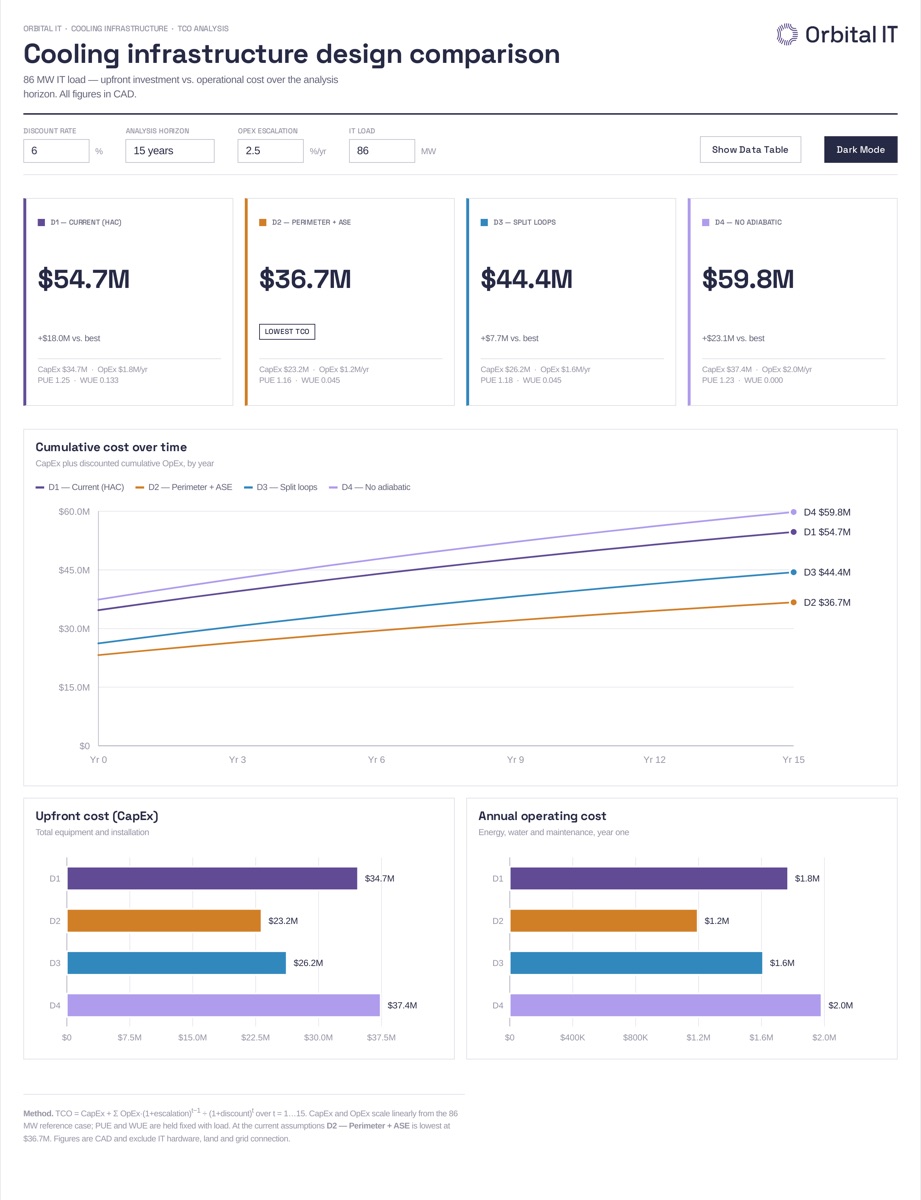
Total Cost of Ownership Dashboard built using CurieOS
Engineers in Control
Trust in AI-generated engineering comes from keeping the engineer in the loop. The engineer isn't reviewing a finished product they had no hand in building; they're directing the process, making the decisions, and using AI to move faster between those decisions. When the final package is ready for sign-off, the engineers already know what's in it because they shaped it along the way. The result is work that's trustworthy and can be completed quickly.