BLOG
CurieOS: A frontier harness for science and engineering work at up to 58% lower cost than Claude Code
November 25, 2026 · Orbital Industries
CurieOS is Orbital Industries' agentic operating system for science and engineering. Today we're sharing a first look at how CurieOS agents perform across frontier benchmarks in science, engineering, biology and software, delivering frontier performance at up to 58% lower cost per task than general-purpose coding harnesses such as Claude Code.
Our customers use CurieOS to solve some of the hardest problems in R&D, from catalyst discovery and formulations chemistry to hardware design and data center engineering. CurieOS lets scientists and engineers build and scale complex workflows, create bespoke applications and collaborate with colleagues and agents, all powered by frontier AI.
The most important performance driver in an agent platform is the agent harness, the software between a frontier model and the work: the tools, context management, execution environment and control loop.
Because Orbital has been dogfooding CurieOS for years as an internal tool, we have a wealth of trace data covering everything from computational materials discovery to agentic CAD and design for manufacture. This enabled us to build a specialized harness that is better at science and engineering than generic coding harnesses. Today we're sharing benchmark data showing how this specialization helps us outperform generic coding agents like Claude Code.
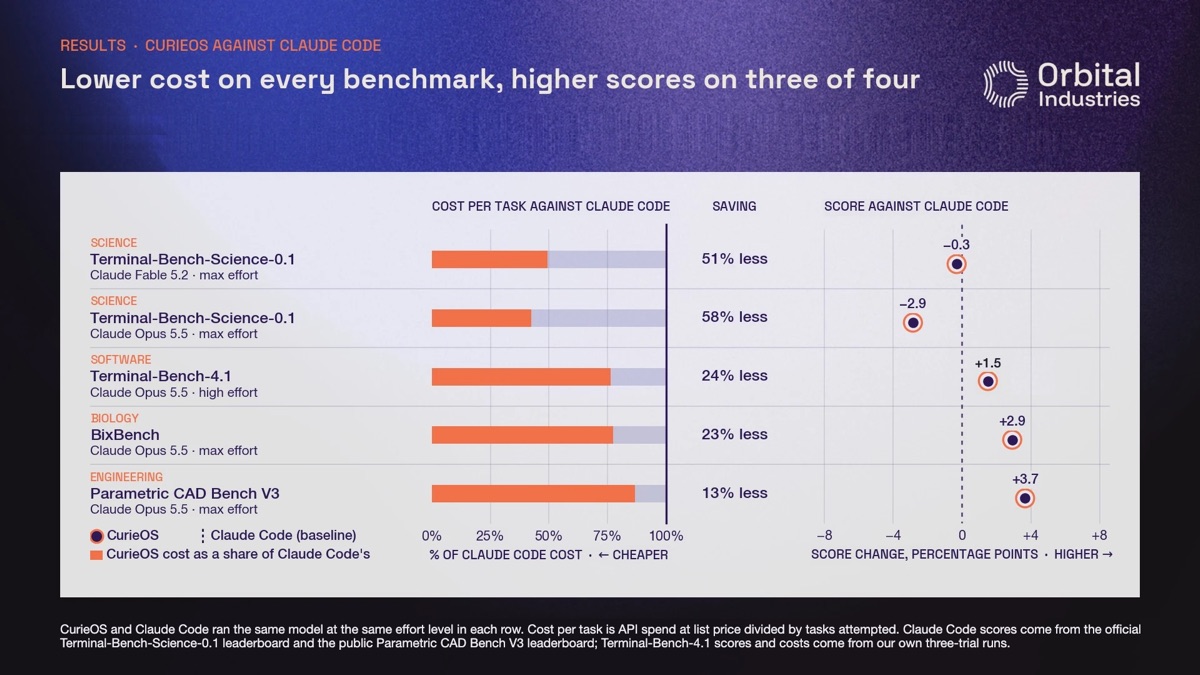
Per-task API cost relative to Claude Code (left) and score difference in percentage points (right), with the model and effort setting matched in each row.
Frontier performance across science and engineering at up to 58% lower cost
01 Half the cost on long science tasks
Multi-step scientific research problems are among the most expensive agent workloads to run. On Terminal-Bench-Science-0.1, CurieOS cut per-task spend by more than half: $25.81 instead of $52.33 with Claude Fable 5.2 (51% less, scoring 74.3% against Claude Code's published 74.6%) and $9.84 instead of $23.21 with Claude Opus 5.5 (58% less, scoring 60.5% against 63.3%). Teams using CurieOS agents can double the impact of their token budgets.
02 Frontier performance or better for less in specialized domains
On Parametric CAD Bench V3, 100 mechanical part-design tasks in FreeCAD spanning text specifications, model edits and 2D engineering drawings, CurieOS with Claude Opus 5.5 scored 64.7%, ahead of the 61.0% top result on the public V3 leaderboard (set by Claude Code with the same model) while costing 13% less per task ($4.97 vs. $5.74). On BixBench, an open-ended computational biology benchmark, CurieOS with Claude Opus 5.5 scored 61.5% against Claude Code's 58.5% (+2.9 percentage points) while cutting per-task cost by 23% ($0.95 vs. $1.23).
03 Benefits extend to general software engineering tasks
On Terminal-Bench-4.1, running Claude Opus 5.5 at high effort on realistic command-line software work, CurieOS scored 61.6% against 60.1% and cut per-task cost by 24% ($2.82 vs. $3.70), showing that the efficiency and accuracy gains hold on everyday engineering workloads without needing max reasoning effort.
The benchmarks
Science
Terminal-Bench-Science-0.1
General science and engineering: 70 research tasks in a terminal, built by Stanford researchers and the Terminal-Bench team.
What it tests and why it matters
Tests: 70 multi-step research tasks across science and engineering, solved end to end in a terminal. The agent sets up the computation, runs it, checks the output and reports the result.
Why it matters: computational chemistry and materials teams run this same workflow when screening coolant or catalyst candidates before committing lab bench time.
Software
Terminal-Bench-4.1
Software and systems work: hard, realistic command-line tasks.
What it tests and why it matters
Tests: realistic command-line software and systems engineering work, including environment setup, build configuration, debugging and system administration.
Why it matters: every simulation campaign and engineering program relies on data pipelines, solver environments and cluster jobs staying reliable.
Biology
BixBench
Computational biology: open-ended bioinformatics analysis questions from FutureHouse (paper).
What it tests and why it matters
Tests: open-ended bioinformatics questions on real experimental datasets. No analysis recipe is provided, so the agent explores the dataset and selects the statistical method itself.
Why it matters: lab characterization runs, thermal test-rig logs and sensor streams arrive as raw files without an analysis script attached, and require the same exploratory judgment.
Engineering
Parametric CAD Bench V3
Mechanical engineering: 100 FreeCAD tasks spanning text-to-CAD, create-and-edit and engineering drawings.
What it tests and why it matters
Tests: 100 mechanical design tasks in FreeCAD by gNucleus. The agent creates editable parts from text specifications, modifies existing parametric models and builds 3D parts from 2D engineering drawings, and each output is graded from 0 to 100% on geometric fidelity and specification match.
Why it matters: machine shops fabricate hardware from editable feature trees and named driven dimensions, and our hardware engineers use parametric CAD workflows of this kind when designing two-phase cold plates.
Coming next: This post is an early preview. Our full technical write-up will add per-task breakdowns, confidence intervals, additional frontier models and the design choices behind the harness.
Method and data
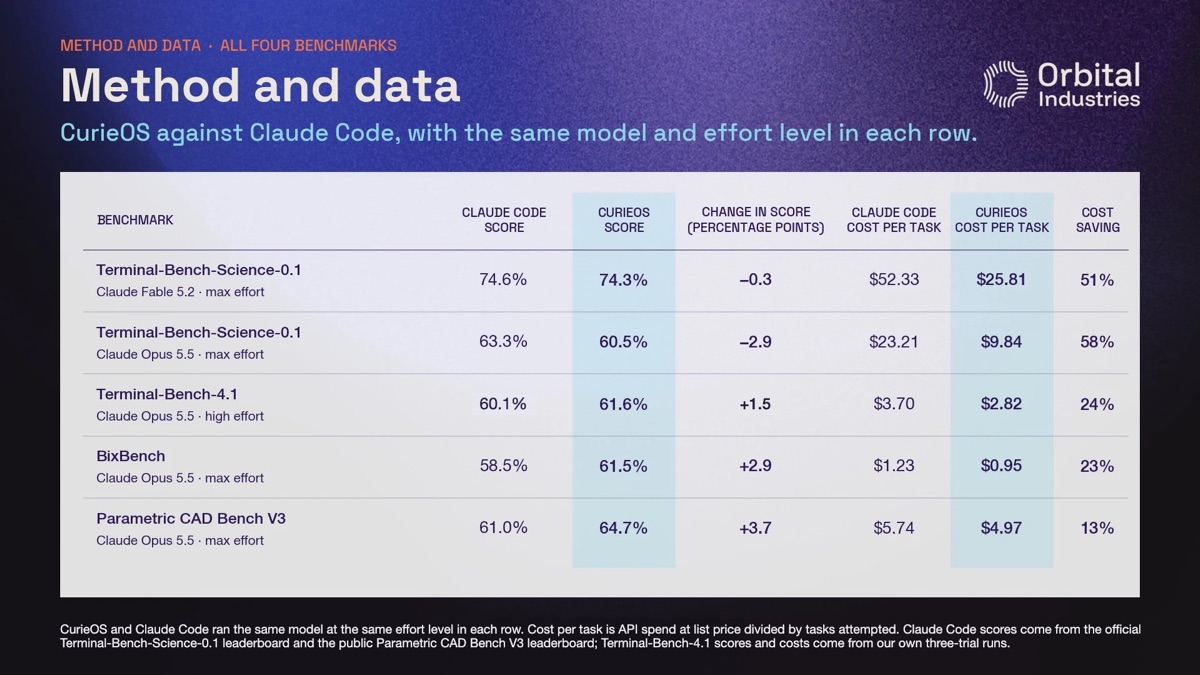
- Controlled comparison. Both harnesses ran the same model at the same reasoning effort level in every row, so only the agent harness changed.
- Baselines. Terminal-Bench-Science-0.1: Claude Code scores from the official Terminal-Bench-Science-0.1 leaderboard and published model results, with Opus 5.5 cost from the leaderboard and Fable 5.2 cost from our own runs. Parametric CAD Bench V3: Claude Code score (61.03%) and cost ($573.94 for 100 tasks) from the public V3 leaderboard. Terminal-Bench-4.1 and BixBench: Claude Code scores and costs from our own paired runs at the matched effort level.
- Repeats. Terminal-Bench-Science-0.1 (Claude Opus 5.5): CurieOS ran three trials per task. Terminal-Bench-4.1: both CurieOS and Claude Code ran three trials per task. Terminal-Bench-Science-0.1 (Claude Fable 5.2), Parametric CAD Bench V3 and BixBench: one trial per task (205 paired questions on BixBench).
- Cost accounting and rounding. Cost per task is API spend at public list price, divided by the number of tasks attempted. Score changes (in percentage points) and cost savings in the figures are computed from unrounded values, so displayed columns may differ by 0.1 percentage points due to rounding.
- Outlier. We excluded one Claude Code task attempt with Claude Fable 5.2 on Terminal-Bench-Science-0.1 that cost $1,140 on its own. Including that run would raise Claude Code's average cost, so excluding it makes the comparison more favorable to Claude Code.